Cable cross-sections and circuit breaker ratings at home
The reference table of cross-sections and protective devices for lighting, sockets and dedicated circuits, and the cases that catch you out.
Which cross-section for which circuit breaker: it is the most ordinary question in the trade. For domestic installations, Book 1 answers it with a table, table 4.11, which sets the maximum rating of the protective device according to the cross-section of the conductors. A 2.5 mm² cable behind a 25 A breaker exceeds that table. This refresher puts those values back on the table, along with the cases where they are not enough to size a circuit.
The cross-section and protection pair, in a nutshell
The principle fits in one sentence: overcurrent protection protects the wiring. According to subsection 4.4.1.1 of Book 1, it interrupts the current before heating becomes dangerous for the insulation, the connections, the wiring and their surroundings. The current-carrying capacity of a cable depends on the cross-section, the insulation, the construction of the wiring, the installation method and the ambient temperature (subsection 4.4.1.4).
Subsection 4.4.3.2 sets two conditions. First, the rated current In of the device is at least equal to the design current IB of the circuit and lower than the current-carrying capacity IZ of the wiring it protects. Second, its conventional operating current If, the current that flows through the device and makes it trip, is less than or equal to 1.45 times IZ, and its conventional non-operating current Inf, the current that flows through it without making it trip, is less than or equal to 1.15 times IZ. So you start from what the circuit needs, choose a cross-section whose current-carrying capacity is sufficient (subsection 5.2.1.2), and the rating sits between the two.
The rule to keep in mind: the protection protects the cable. An appliance that needs more power never justifies raising the rating without reviewing the cross-section.
Table 4.11 of Book 1
For domestic installations, subsection 4.4.1.4 gives the maximum current of the circuit breaker or fuse protecting a circuit, according to the cross-section of the conductors. Extract:
| Conductor cross-section | Circuit breaker, maximum current | Fuse, maximum rated current |
|---|---|---|
| 1.5 mm² | 16 A | 10 A |
| 2.5 mm² | 20 A | 16 A |
| 4 mm² | 25 A | 20 A |
| 6 mm² | 40 A | 32 A |
| 10 mm² | 63 A | 50 A |
These are maximums, not recommended values. A minimum cross-section rule comes on top (subsection 5.2.1.2 and table 5.1): outside machines and appliances, insulated conductors smaller than 2.5 mm² are prohibited, with exceptions. 1.5 mm² is allowed for circuits with no socket outlet, except for a single 2.5 A socket built into a luminaire. Hence the two basic pairs: a lighting circuit without sockets in 1.5 mm² under 16 A at most, a socket circuit in 2.5 mm² under 20 A at most.
Two details from subsection 5.3.5.2 for domestic work: a final circuit supplies at most eight single or multiple socket outlets. And sockets, lighting and other fixed appliances may share the same final circuit, except for the fixed appliances on the dedicated circuits referred to in subsection 5.2.1.2: the requirements for socket circuits then apply, a fixed appliance or a group of fixed appliances controlled by a common switching device counting as one socket outlet.
Dedicated circuits
In domestic installations, subsection 5.2.1.2 requires a dedicated circuit, and states that the cross-section is chosen according to the power of the appliance:
- Appliances of 2600 W or more: the text covers every appliance or machine with a rated power of 2600 W or more that is installed in a fixed position, or movable but kept in a fixed position, two categories defined in section 2.8.2. It is supplied separately by a dedicated circuit.
- The washing machine, the dishwasher, the tumble dryer: a dedicated circuit each, whatever their power.
- The electric cooker, hob and oven: a dedicated circuit each as well. The cross-section follows the power, and the rating stays within the limits of table 4.11.
- Fixed electric heating: its appliances are supplied by one or more dedicated circuits, whatever their power.
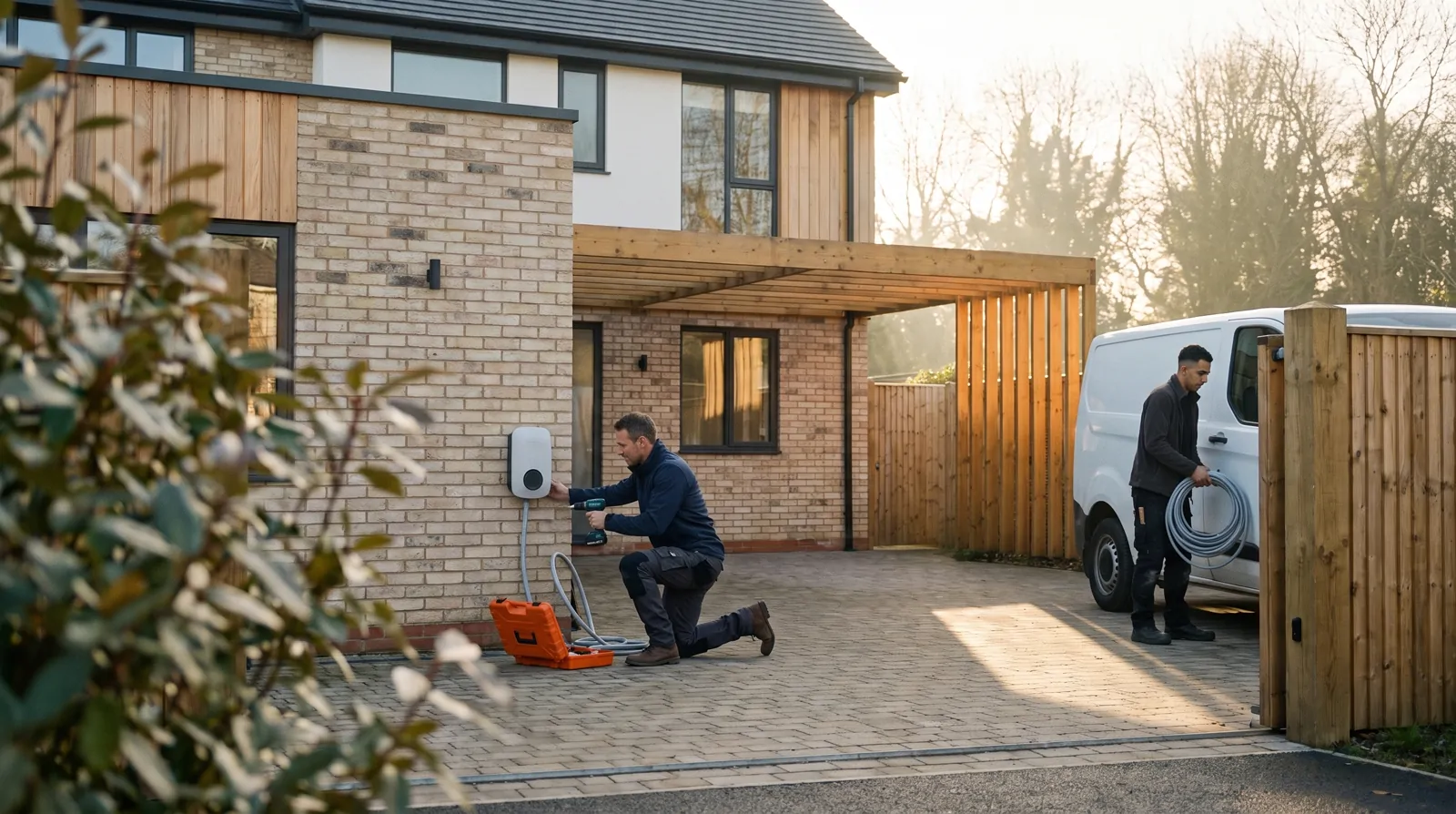
- The recent heavy consumers: for the charging point, section 7.22.3 requires a dedicated circuit per connection point. The heat pump is assessed against the 2600 W threshold for appliances or machines (movable or not) in a fixed position; applying it to a specific appliance is a matter for the approved body.
The cases that catch you out
Table 4.11 gives a ceiling for the rating per cross-section. It does not say that a cross-section is sufficient in every condition. Three situations call for a calculation.
- Long distances. The feed to a garden shed, a detached garage or an annexe at the bottom of the plot can be long. The cross-section must then also take voltage drop into account: even if the protection does not change, a larger cross-section may be needed.
- Voltage drop in general. According to section 5.2.5, it is limited to the values described in the rules of good practice, and subsection 5.2.1.2 requires it to remain compatible with the safe operation of the equipment supplied. It is calculated, not guessed.
- The installation method. A cable buried in insulation, circuits bundled in the same conduit or cable tray, a buried run: the installation method, the surroundings and the temperature are among the parameters of the current-carrying capacity (subsection 4.4.1.4). The same 2.5 mm² does not carry the same load laid on its own on the surface as squeezed against other circuits. The current-carrying capacity is calculated according to the rules of good practice.
When in doubt, calculate, or choose a larger cross-section.
These values on the single-line diagram
For domestic installations, subsection 3.1.2.2 requires the single-line diagram to show at least the type, cross-section and number of conductors, the installation method, and the type and characteristics of the protective devices. That is where the inconsistencies show: XVB 3G1.5 under a 20 A breaker exceeds the rating in table 4.11 without anyone having to open the board. What Book 1 provides for the inspection by the accredited body, including the content of the report, is covered in our article on how the RGIE inspection unfolds.
The right moment to check these pairs is while entering the diagram, not the night before the inspection. That is the principle behind Amperio’s continuous checks: each circuit is checked against Book 1 as you enter it, circuit breaker ratings and conductor cross-sections included, and a discrepancy is flagged at the exact spot on the diagram.
Sources
- RGIE, Book 1, section 4.4.1 (FPS Economy, version of 29.10.2025)
- RGIE, Book 1, section 4.4.3 (FPS Economy, version of 29.10.2025)
- RGIE, Book 1, section 5.2.1 (FPS Economy, version of 29.10.2025)
- RGIE, Book 1, section 5.2.5 (FPS Economy, version of 29.10.2025)
- RGIE, Book 1, section 5.3.5 (FPS Economy, version of 29.10.2025)
- RGIE, Book 1, section 2.8.2 (FPS Economy, version of 29.10.2025)
- RGIE, Book 1, section 3.1.2 (FPS Economy, version of 29.10.2025)
- RGIE, Book 1, section 7.22.3 (FPS Economy, version of 29.10.2025)
This article is informative. It replaces neither the RGIE (Book 1) nor the advice of your inspection body.
A free job site for 7 days, no credit card.