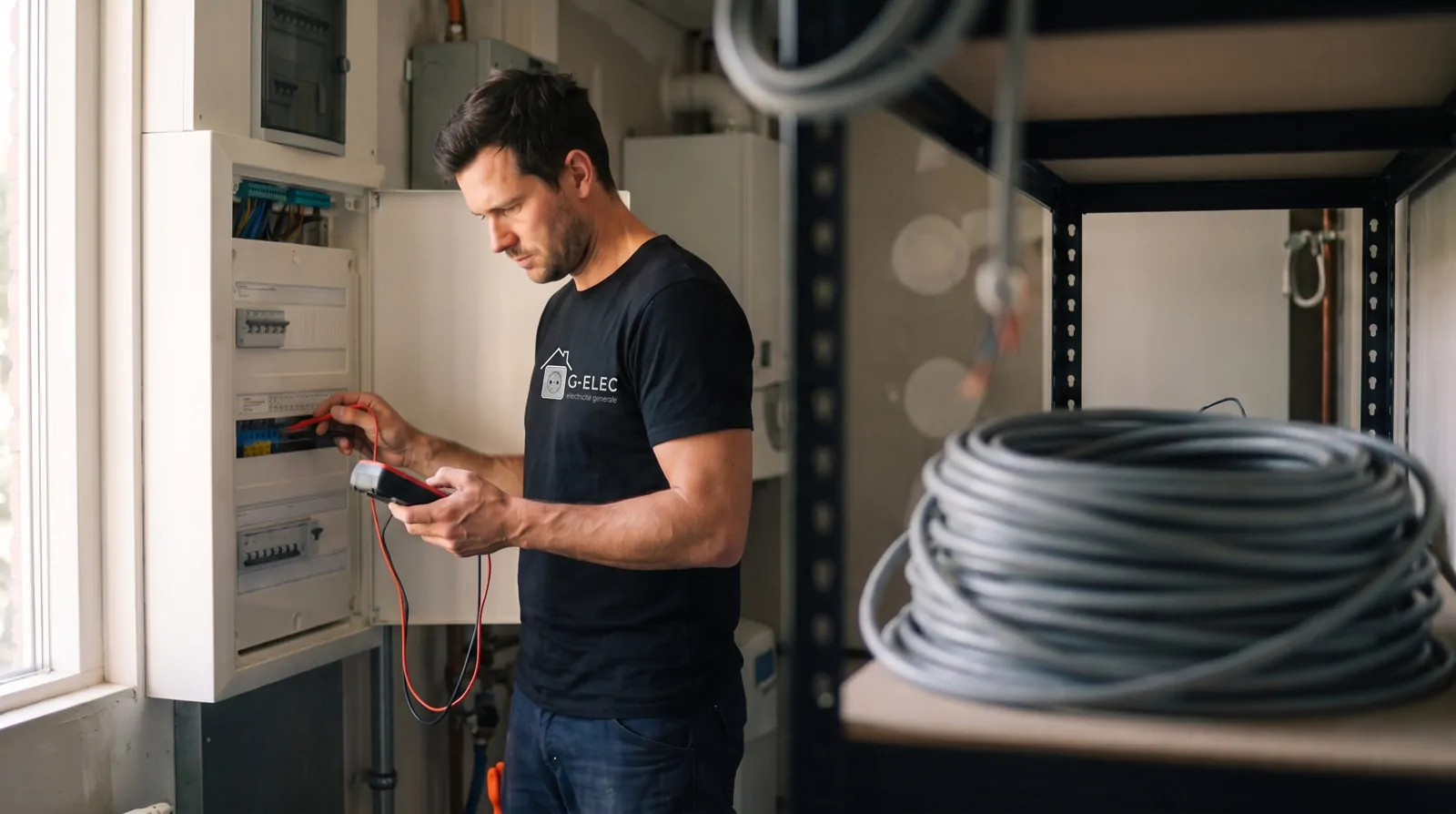
RGIE inspection: how the accredited body’s visit unfolds
What Book 1 of the RGIE provides for inspection by an accredited body: checks, measurements, report and follow-up, with a checklist to prepare the visit.
Apart from the exceptions set out in the text, every low or extra-low voltage electrical installation undergoes a compliance inspection before it is put into use, followed by inspection visits, carried out on site by an accredited body or by the competent authority (chapters 6.4 and 6.5 of Book 1 of the RGIE). Here is what the text provides for these inspections, what the report contains, the possible outcomes, and a checklist to prepare the visit.
Why and when an inspection
Book 1 covers several situations. For domestic installations, these include:
- Putting a new installation into use. The compliance inspection takes place before the installation is put into use (section 6.4.1). An installation in which infringements are found at that inspection may not be put into use (subsection 9.1.3.1), and whoever makes the supply available to a new installation checks that the report confirming compliance is present (subsection 6.4.6.2).
- A significant modification or extension. It undergoes a compliance inspection before it is put into use, limited to the added or modified part; if the modification has an impact on the unmodified part, that part is inspected for the modified characteristics (subsection 6.4.7.3). Examples given in section 2.11.2 include the non-identical replacement of a distribution board and the addition of a circuit to a domestic installation.
- The sale of a dwelling with an old installation. For an old domestic installation, whose execution began before 1 October 1981, in the cases covered by section 8.4.2, the seller must have an inspection visit carried out. Our guide on the electrical file when selling covers this case.
- The periodic inspection visit. After the compliance inspection, a domestic installation receives inspection visits at least every 25 years (section 6.5.2).
What the inspection covers
The compliance inspection is carried out with the installation de-energised and includes administrative checks, visual checks, checks by testing and checks by measurement (section 6.4.1). The inspection visit has the same components, and it must be possible to de-energise the installation during the visit (section 6.5.1). The competent ministers may lay down by decree detailed arrangements for carrying out these checks (sections 6.4.2 to 6.4.4 and 6.5.3 to 6.5.6). How they apply to a specific installation is a matter for the accredited body.
The file: diagrams and plans
For a domestic installation, the compliance inspection report certifies, among other things, that the installation has been carried out in accordance with the single-line diagrams and position plans (subsection 6.4.6.4). These documents are kept up to date and on site (subsection 3.1.2.1). They state the address of the installation, the name, capacity and VAT number (where applicable) of the person responsible for carrying out the works, and their number, version and the date of that version (section 3.1.2).
Each lighting point, socket-outlet and control unit on the position plan carries the circuit letter and order number from the diagram (subsection 3.1.2.1). The full requirements are detailed in our article on what the RGIE expects from the single-line diagram. Plan the copies you need: the file of a domestic installation is drawn up in two copies held by the owner (section 9.1.2), and the accredited body keeps a copy of the report for at least five years, together with the single-line diagrams and position plans (subsection 6.4.6.1).
Measurements and checks
Book 1 and the report contents it prescribes list the points examined in domestic installations:
- The dispersion resistance of the earth electrode. It is measured at the compliance inspection (subsection 6.4.5.2), and the report certifies that the installed RCDs are suited to its value (subsection 6.4.6.4). If it exceeds 30 ohms, subsection 4.2.4.3 requires at least two high or very high sensitivity RCDs, each covering at most sixteen socket-outlets, with further provisions. The detail is in our article on earthing.
- Insulation. The insulation resistance is measured for each circuit, with current-using appliances disconnected, and is at least 1,000 times the test voltage in volts. For a circuit of 500 V or less, excluding extra-low voltage supplied by a safety transformer, the test voltage is 500 V DC and the minimum resistance 500 kΩ (subsection 6.4.5.1, table 6.1). These measurements may be omitted on measuring and control installations and on extra-low voltage installations (subsection 6.4.5.1). Inspection visits include at least these measurements (section 6.5.6).
- The RCDs. The inspection visit report records the check of their operation via their own test button, and the check of fault loops and of their correct connection by creating a fault current between 2.5 and 2.75 times their sensitivity (subsection 6.5.7.2). Their arrangement follows subsection 4.2.4.3: at least one RCD of at most 300 mA at the origin, and immediately downstream at least one high or very high sensitivity RCD to which at least the following are connected: socket-outlets not intended for fixed or stationary appliances or machines, lighting, locations containing a bath or shower, washing machines, tumble dryers and dishwashers.
- Continuity. The check covers the main and supplementary equipotential bonding, and the protective conductors of socket-outlets and of fixed class I equipment (subsections 6.4.6.4 and 6.5.7.2).
- Equipment and protective devices. The compliance report covers the correct selection, assembly and installation of fixed equipment, and certifies that the overcurrent protective devices are suited to the circuit cross-sections. The inspection visit report also records the condition of fixed equipment, including switches, socket-outlets and connections in the boards, and the measures for protection against electric shock (subsections 6.4.6.4 and 6.5.7.2).
The possible outcomes
The report is sent to the owner, manager or operator, in writing or electronically, and filed in the installation’s file (subsections 6.4.6.1 and 6.5.7.1).
- Compliant installation. After a compliance inspection, the report certifies that the inspection agent has endorsed the single-line diagrams and position plans, and states the date by which the inspection visit must be carried out at the latest (subsection 6.4.6.4). Until 31 October 2026, it also certifies that the RCD at the origin of the installation has been sealed; this seal is removed from 1 November 2026 (royal decree of 13 August 2026).
- Infringements at the compliance inspection. The installation or part of the installation concerned may not be put into use (subsection 9.1.3.1).
- Infringements at an inspection visit. The report concludes non-compliance and sets the date before which a follow-up visit is to be carried out by the same body. The work is done without delay and all appropriate measures are taken so that, if the installation remains in service, the infringements do not pose a danger to people and property (subsections 6.5.7.2 and 9.1.3.2). The report recalls the obligation to have the removal of the infringements verified by a new inspection visit from the same accredited body at the end of the one-year period (subsection 6.5.7.2).
- Sale of an old installation. If the visit carried out at the sale (section 8.4.2) results in a negative report, the buyer must have a new visit carried out at the end of an 18-month period starting on the date of the deed of sale, by the accredited body of their choice.
The night-before checklist
A few checks the night before avoid gaps between the file and the installation:
- The file is complete and up to date. Single-line diagrams and position plans, with address, identity of the person responsible for the works, number, version and date. Every change made on the job is in there, including the circuit added at the last minute.
- The referencing matches. Same letters and order numbers on the diagram and on the plan, and protective devices marked in the board, unless any possibility of confusion is ruled out (subsections 3.1.2.1 and 3.1.3.1).
- The boards are accessible. Nothing stored in front of them.
- The shutdown is planned. The compliance inspection is carried out de-energised, and it must be possible to de-energise the installation during a visit: let the occupants know.
- The RCDs trip on the test button. This check appears in the inspection visit report.
- Someone is present to open up, show the boards and answer questions.
The useful habit: walk the installation again, diagram in hand. Every gap between the paper and reality you find the night before can be fixed before the visit.
A file kept up to date throughout the job makes this preparation easier: with Amperio, the diagram and the plan are updated together, and the complete electrical file is exported as a PDF, ready to hand to the accredited body.
Sources
- RGIE, Book 1, section 2.11.2 (FPS Economy, version of 29.10.2025)
- RGIE, Book 1, section 3.1.2 (FPS Economy, version of 29.10.2025)
- RGIE, Book 1, section 3.1.3 (FPS Economy, version of 29.10.2025)
- RGIE, Book 1, section 4.2.4.3 (FPS Economy, version of 29.10.2025)
- RGIE, Book 1, section 6.4 (FPS Economy, version of 29.10.2025)
- RGIE, Book 1, section 6.5 (FPS Economy, version of 29.10.2025)
- RGIE, Book 1, section 8.4.2 (FPS Economy, version of 29.10.2025)
- RGIE, Book 1, section 9.1 (FPS Economy, version of 29.10.2025)
- Royal decree of 13 August 2026 amending parts 4 and 6 of Book 1 (FPS Economy, published 15.09.2026, applicable from 1.11.2026)
This article is informative. It replaces neither the RGIE (Book 1) nor the advice of your inspection body.
A free job site for 7 days, no credit card.