Dictating your job site: the on-site survey without a keyboard
How voice and AI transform the survey: you describe the rooms as you walk, and the diagram and plan draw themselves.
With the classic method, the survey forces you to write everything down twice. Once on the job site, once back at the workshop. This article shows how voice dictation changes that mechanic, what it looks like in practice on a job site, and where the limits are.
The classic survey, and what it costs
The routine is familiar. You walk through the dwelling with a notebook, a tape measure and a pencil. You note the rooms, the sockets, the lighting points, the circuits to create. Some things stay in your head: "the utility room, I’ll remember it". Then in the evening, or at the weekend, everything has to be entered again: redraw the position plan, build the single-line diagram, make the circuit numbers match between the two.
That is where the problems are born:
- Omissions. What was not noted on site no longer exists in the evening. The dedicated circuit promised to the client, the socket behind the cellar door.
- Double entry. Every piece of information is written once in pencil, then once in the drawing tool. Two opportunities to get it wrong.
- The gap. Days can go by between the survey and the drawing. The file then gets built from memory.
The principle: describing the rooms as you walk
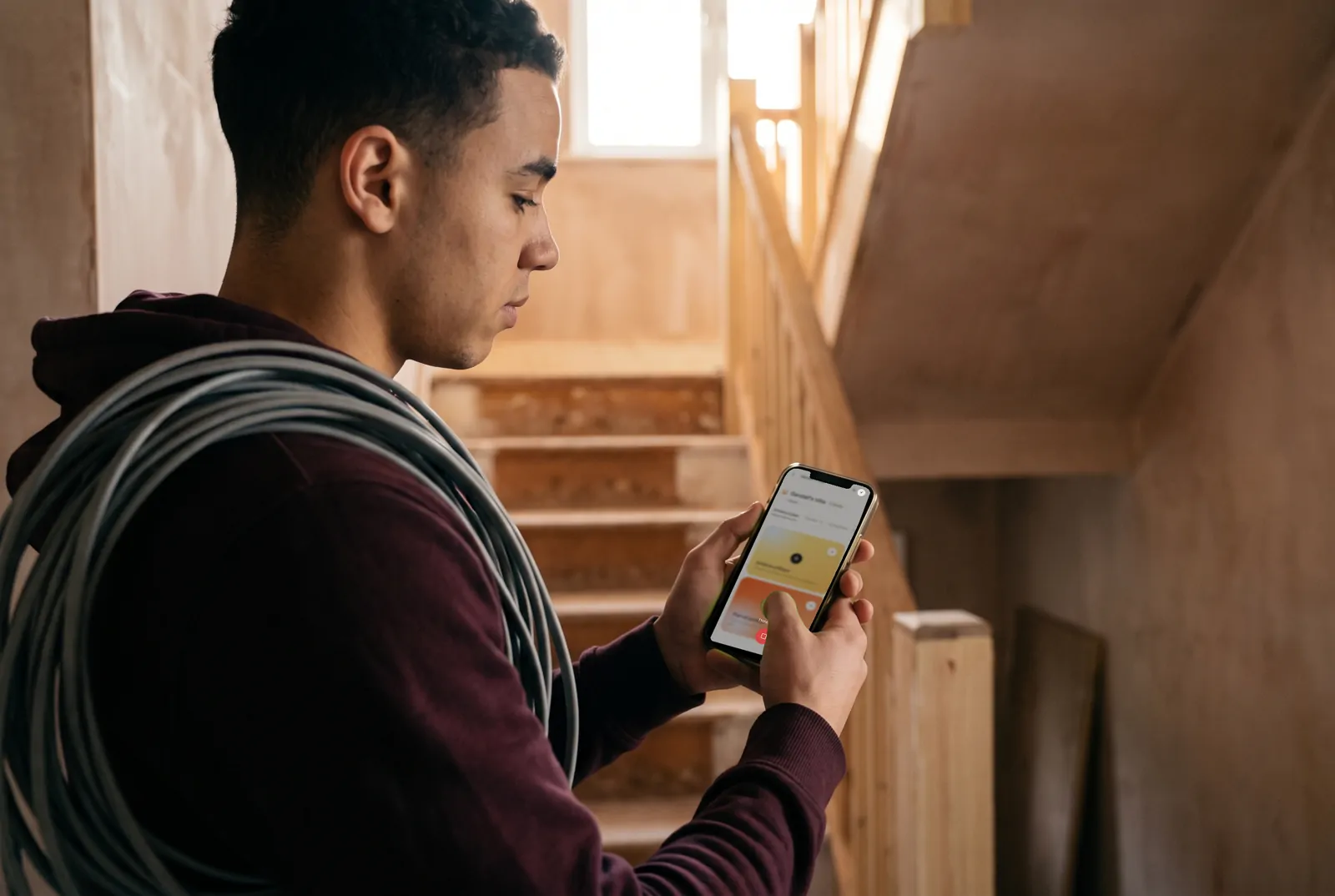
With Amperio, the survey is done on site, room by room, by voice or by hand. You walk into the kitchen and describe what you see or what you are about to fit: "in the kitchen, the worktop sockets and the dishwasher circuit". The elements land in the right room of the position plan, and the single-line diagram is built at the same time, with the same referencing on both sides.
You move on to the next room and carry on. Unsure about a phrasing? Every symbol, every wire and every label stays editable on screen: you move a socket, you rename a circuit. Voice is a means of input, not a definitive commitment.
Meanwhile, each circuit is checked against the RGIE (Book 1) as you enter: RCDs, circuit breaker ratings, conductor cross-sections. A missing RCD or a cross-section that is too small is flagged at the exact spot on the diagram, with the proposed correction, while you are still in the room concerned. For what comes next, see our article on how the RGIE inspection unfolds, which sets out what Book 1 provides for the accredited body’s visit.
What it changes in practice
The main change fits in one sentence: the diagram and the plan already exist by the time you climb back into the van. Not a rough draft to re-enter, a plan and a diagram built together, left to proofread and adjust.
- No more double entry. The information is captured once, at the moment you have it in front of you.
- Fewer omissions. What is said is saved in the job site, ready to proofread. The notebook no longer has to carry the memory of the job site.
- Evenings recovered. The office work happens during the visit: the evening re-entry and reconciliation go away, the proofread remains. The effect depends on the size of your job sites and your habits.
- Problems spotted on site. An RGIE remark flagged during the survey can still be settled on paper, before the works.
The limits, honestly
Dictation does not remove the proofread. At the workshop, you go back over the plan and the diagram, check the positions, adjust what was placed or phrased badly. As with any dictation, a sentence can be misheard, especially in noise, and need correcting. And above all, voice does not replace the professional’s eye: you are the one who decides the number of circuits, the cross-sections, what the client agrees to pay. The AI suggests, you decide.
To see the full run-through: we described a typical day, from the morning survey to the export of the PDF file, in From survey to PDF file: how a typical job runs. And if you want to try it on a real job site, you can start for free.
This article is informative. It replaces neither the RGIE (Book 1) nor the advice of your inspection body.
A free job site for 7 days, no credit card.