Before/after photos and shared tasks: the job site that reassures
Documenting the job site as you go: before/after photos, team tasks and presenting to the client.
On an electrical job site, most of the work ends up hidden: in the walls, under the floors, behind the plasterboard. That is why documenting the job site matters: it makes visible what was done, at the moment it was still visible.
Why document as you go
Documenting after the fact is already too late: the chase has been filled in, the old board has gone to the skip. Useful documentation happens during, as you go, and it helps on three levels:
- Questions settled with a picture. A photo of the chase before it was filled shows where the cable runs, without relying on anyone’s recollection.
- The client kept informed. They do not see the progress, they endure it: noise, dust, open walls. Regularly showing them what is moving forward helps them follow the job.
- The team aligned. When the state of the job site is visible to everyone, the morning questions ("where are we with the bathroom?") find their answer in the job site itself.
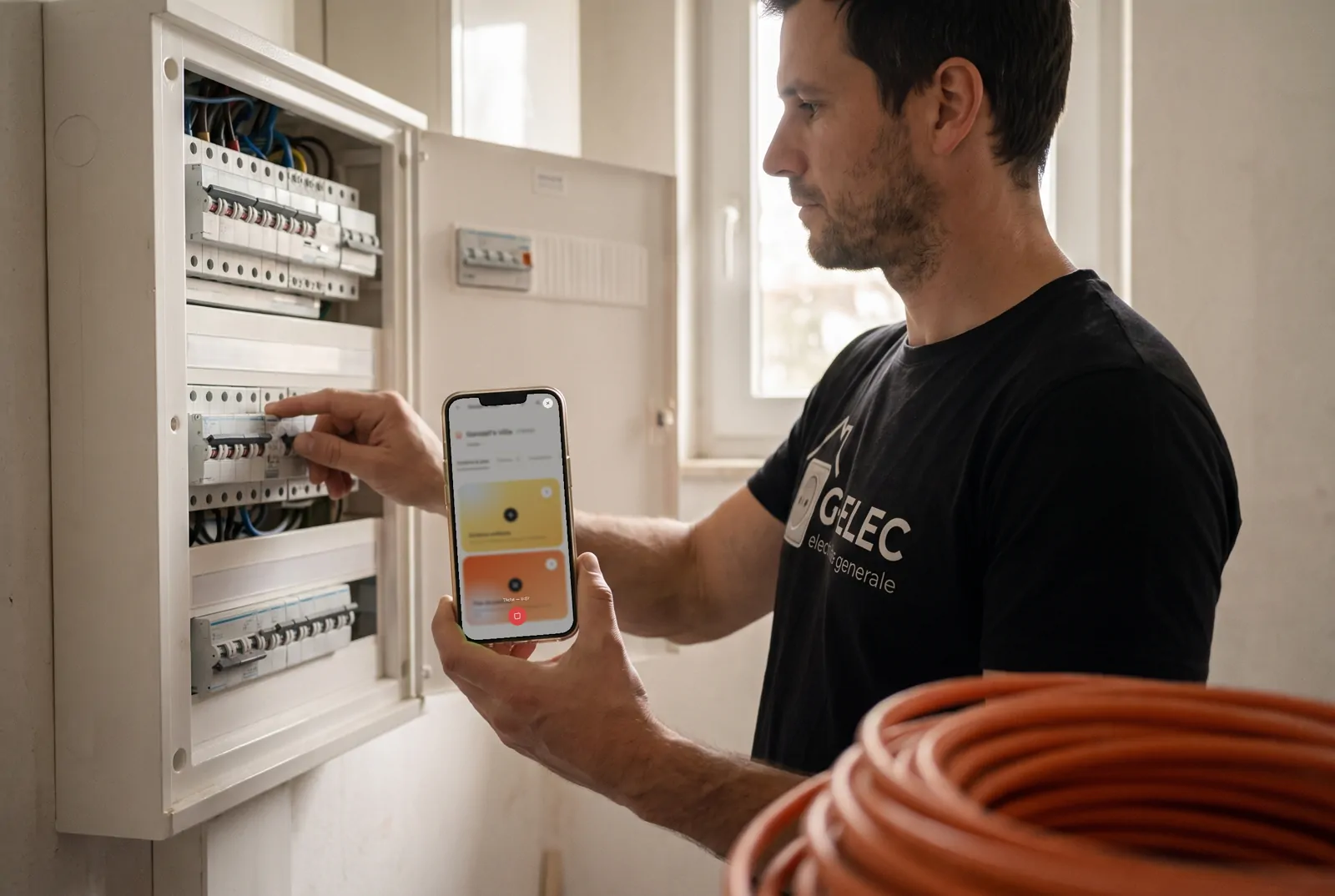
In Amperio, this documentation lives in the same place as the rest of the file: the plan, the diagram, the photos and the tasks belong to the same job site. And a cellar with no signal does not stop the follow-up: your recent job sites stay viewable, and you keep creating tasks and taking photos, which synchronise as soon as the connection returns.
Before/after photos
The principle: the "before" photo and the "after" photo go together. Not two shots lost in the phone’s camera roll among the family pictures, but photos attached to the job site, telling a transformation:
- The chase open with its cables, then filled in. A record of the run, a record of the reinstatement.
- The distribution board before and after replacement: the old tangle, then the clean rows with their labels.
- The boxes and the conduits before the walls are closed: what will no longer be visible once the walls are shut.
These photos keep a record of what is in the walls, long after the invoice. On the electrical file when selling, see our article on the sale of the property.
Tasks shared with the team
Photos document what is done, tasks organise what remains. On a job site with several people, the shared list replaces the whiteboard in the van: everyone sees what is done and what is left to do.
- Sub-tasks to break down the big pieces: "distribution board" splits into fitting the enclosure, wiring the RCDs, labelling, referencing.
- Voice notes attached to the task: quicker to create than a message, more precise than a recollection. The instruction dictated on site is shared with the team. It is the same principle as the dictated survey: capture the information at the moment you have it in front of you.
- Tasks to tick off: what is done gets ticked, what remains stays visible to everyone. Nobody has to assume someone else is handling it.
Show rather than tell
On Friday, when the client asks where things stand, two options. Tell: "we’ve made good progress, next week we start on the upstairs". Or show: the tablet on the kitchen table, the plan of the dwelling, the before/after photos, the tasks ticked off and the ones remaining. With the second option, the client no longer follows the job site through what they hear, but through what they see.
The same living-file logic applies to the end of the job: the full run-through, up to the PDF export for the inspection body, is described in From survey to PDF file: how a typical job runs.
Photos to explain the invoice
Visible work is easier to explain. Next to a line item on the invoice, a photo and a closed task show what was done. The extra charge for the unplanned oven line rests on the photo of the old line. The "reinstatement" item rests on the before/after photos.
The reflex to build: a photo before filling in, a photo before closing up, a photo before throwing away. Three moments, three photos.
This article is informative. It replaces neither the RGIE (Book 1) nor the advice of your inspection body.
A free job site for 7 days, no credit card.